Good article by Luke Timmerman at The Seattle Times regarding Imperium and the importance of biodiesel being able to compete on price.
http://seattletimes.nwsource.com/html/businesstechnology/2003470213_biodiesel10.html
One of my favorite quotes from John Plaza "You have to be competitive on a cost basis, not just for the environmental or social play," said Plaza. "Otherwise, this would never grow the way we want it to grow."
And Luke was kind enough to quote me . . .
Eric Bowen, an energy expert with Sigma Capital in San Francisco, said that among the 100 biodiesel business plans he's reviewed there are three types of companies: agribusiness giants like Archer Daniels Midland with lots of cash and talent; old hippies working on small projects that will mostly fail; and a new breed of "pure-play" venture-backed companies focused on making large volumes of biodiesel.
Imperium, he said, is in the third camp. Bowen said he's not sure the company has "a secret sauce" for success, but Chief Executive Martin Tobias, who took Seattle-based Loudeye public in the dot-com heyday, has to be taken seriously.
"Whether these guys are riding a bubble of biodiesel or building a business for the long term is a fair and open question," Bowen said. "But Martin and his team certainly know what they are doing."
Sunday, December 10, 2006


Friday, November 17, 2006
Great Women of Biodiesel Calendar
I strongly recommend that everyone rush out and buy a women of biodiesel calendar for everyone on their holiday list . . . and if not that, at least one for yourself. These are all amazing pioneering women and if enough sales are generated to payback the cost of printing, half the proceeds go to support the important work of the Biodiesel Counsel of California.
You can find the calendar here:
http://www.greenmeansgocars.com
Here is Sienna's original email describing the calendar:
Hey there,My dream of making a calendar featuring some of the amazing women in this community has become a reality. You can see it at the BioFuel Oasis or the Ecology Center in Berkeley. There is a way to buy it on my website, too. If I make any money from the calendar, I'm going to split my profits with the Biodiesel Council of California.
The calendar has pictures of and writing by:
Jennifer Radtke www.biofueloasis.com www.backyardbiodiesel.org
Emily Butterfly www.bigtadoo,org www.cleanfuelcaravan.org
Jolie Ginsburg www.incadventures.com
SaraHope Smith www.biofueloasis.com www.biodieselcouncil.org
Amy Sinsheimer www.sfbiofuels.org
Jessica Redford Hoelle www.cafepress.com/vexpat
Sarah Rich www.worldchanging.com www.inhabitat.com
Gretchen Zimmermann www.biofueloasis.com
Kimber Holmes www.paxfuel.com
Sunny Beaver www.ybiofuels.org
Melissa Hardy www.biofueloasis.com www.veggiebus.com
and myself www.greenmeansgocars.com
Peas,
Sienna
http://www.greenmeansgocars.com
You can find the calendar here:
http://www.greenmeansgocars.com
Here is Sienna's original email describing the calendar:
Hey there,My dream of making a calendar featuring some of the amazing women in this community has become a reality. You can see it at the BioFuel Oasis or the Ecology Center in Berkeley. There is a way to buy it on my website, too. If I make any money from the calendar, I'm going to split my profits with the Biodiesel Council of California.
The calendar has pictures of and writing by:
Jennifer Radtke www.biofueloasis.com www.backyardbiodiesel.org
Emily Butterfly www.bigtadoo,org www.cleanfuelcaravan.org
Jolie Ginsburg www.incadventures.com
SaraHope Smith www.biofueloasis.com www.biodieselcouncil.org
Amy Sinsheimer www.sfbiofuels.org
Jessica Redford Hoelle www.cafepress.com/vexpat
Sarah Rich www.worldchanging.com www.inhabitat.com
Gretchen Zimmermann www.biofueloasis.com
Kimber Holmes www.paxfuel.com
Sunny Beaver www.ybiofuels.org
Melissa Hardy www.biofueloasis.com www.veggiebus.com
and myself www.greenmeansgocars.com
Peas,
Sienna
http://www.greenmeansgocars.com
Tuesday, September 12, 2006
Good New York Times Article
I had a few good conversations with Susan Moran, a very nice professor of journalism at Boulder who also freelances for the NYT. Below is her recent article (and a link to the article on the NYT website) on biodiesel.
http://www.nytimes.com/2006/09/12/business/smallbusiness/12bio.html?_r=1&adxnnl=1&oref=slogin&adxnnlx=1158120445-bEsgK5uhEfZV2bmT2+hjdA
Biofuels Come of Age as the Demand Rises
By SUSAN MORAN
Published: September 12, 2006
BARACK OBAMA is not a farmer, but he believes in biodiesel and the votes of farmers who produce soybeans and other crops for it. Senator Obama, Democrat from Illinois, spoke last month at an event to celebrate plans for a new biodiesel plant in Cairo, Ill. His presence was a welcome endorsement for a budding industry.
Nile Ramsbottom, of Renewable Energy Group in Ralston, Iowa.
On the day that Mr. Obama joined the Renewable Energy Group in announcing that it would build a 60-million-gallon-a-year refinery, the company said it had garnered $100 million in financing, the largest equity investment in biofuels so far. The infusion came from the American division of Bunge Ltd., a major food processor; two venture-capital funds controlled by Natural Gas Partners of Irving, Tex.; and ED&F Man Holdings Ltd., a global shipper of grains.
The investment underscores how the biodiesel industry is coming of age as demand for renewable fuels increases. The businesses range from soybean farmers in the Midwest seeking new markets to coastal start-ups with an environmental mission. Both camps are attracting a flow of money from venture capitalists and corporations alike.
Traditionally, soybean farmers dominated the biodiesel business, but lately a broader array of entrepreneurs is joining the pack, creating a curious convergence of environmentalists, farmers and investment bankers. Growth in the last year has been “phenomenal, almost frightening,” said Joe Jobe, chief executive of the National Biodiesel Board, a trade association.
But the ability of entrepreneurs to succeed in the long term will depend on much more than acres of oil-rich crops or deep pockets, industry players and analysts say.
“You don’t necessarily have to be a national player, but you need to optimize distribution within your region,” Mr. Jobe said.
And you need to make high-quality commercial biofuel while promising consistent quality to your customers, he added.
“Some people say anybody can make biodiesel if he can bake a cake,” Mr. Jobe said. “Have you ever baked a cake involving methanol, sodium hydroxide and other chemicals that could start fires?”
About 76 commercial biodiesel plants are in production today, up from 22 in 2004. The average business operates one plant that yields 30 million gallons a year of fuel and costs up to $20 million to build. Some companies are planning refineries capable of brewing up to 100 million gallons a year.
Nationwide production of the fuel tripled last year over 2004 to 75 million gallons. The board estimates that production will double this year, but Mr. Jobe estimates that the number could reach as much as, if not more, than 250 million gallons by year’s end.
That’s still a drop in the bucket compared with the nearly 140 billion gallons of gasoline the United States consumes each year. It also pales in comparison with ethanol. Last year, the global biofuels market totaled $15.7 billion in sales, of which only $1.6 billion came from biodiesel. That number could jump to $7.1 billion by 2015, says Clean Edge, a research company in Portland, Ore. But biodiesel has immediate appeal in that it does not require modifications of a diesel engine. It also requires far less fossil fuel to make than, say, corn-based ethanol.
Biodiesel comes from soybean, palm or oil-seed plants like canola and mustard, as well as from animal fats. Corn oil can also be extracted for fuel. Some start-up companies and university scientists are testing algae, which is attractive because it would not dip into the nation’s feedstock reserve.
Typically blended with conventional diesel, biodiesel burns cleaner and releases fewer pollutants, including carbon monoxide and particulate matter. Several factors are driving growth, including a federal ruling on low-sulfur diesel, state mandates on renewable fuels and concern about climate change and dependence on foreign oil.
But the strongest incentives are high petroleum prices and federal tax credits. “If one of those two fall, the industry’s growth would slow significantly, but would survive,” said Eric Bowen, a lawyer who helped found San Francisco Biodiesel, which plans to build refineries based on rendered animal fat and recycled vegetable oil from restaurants. “But if both fall away, the biodiesel industry would be in serious trouble.”
The federal excise tax credit, aimed at curbing pollution, offers producers and distributors of agri-biodiesel, which comes from virgin crop oils and animal fats, $1 for every gallon of biodiesel they blend with regular diesel. This means that even producers who blend their 100-percent pure biodiesel with only 1 percent of petroleum-based fuel can reap the credit.
Most biodiesel sold in the United States is a blend of 20-percent pure biodiesel and 80-percent conventional diesel fuel, called B20.
So far, commercial demand has outpaced supply. Renewable Energy plans to produce 460 million gallons from several of its plants. The company was spun off from a soybean farmer cooperative called West Central, which built its first biodiesel plant in Ralston, Iowa, in 1996. Nile Ramsbottom, the president of Renewable Energy, said he expected sales to reach $740 million in 2010, a rise from $116 million last year.
Without forming alliances and not managing risk between energy and agriculture commodities, many start-ups will falter, some industry experts contend.
“Plants are going up everywhere,” said Gene Gebolys, founder of World Energy Alternatives in Chelsea, Mass. “But individual plants must be part of a network in which products can get to the best markets.” The company expects to exceed $100 million in sales this year from producing biodiesel from soybeans, canola and animal fat.
The first biodiesel business to receive venture-capital financing was Seattle Biodiesel, which recently changed its name to Imperium Renewables. Since spring of last year, three firms have invested $10 million in the company: Nth Power of San Francisco; Technology Partners in Palo Alto, Calif.; and Vulcan Capital, led by Paul G. Allen, the co-founder of Microsoft.
Imperium’s Seattle refinery produces five million gallons a year, and the company is building a refinery in Grays Harbor, Wash., able to produce 100 million gallons a year. Imperium now buys soybean oil from the Midwest, a costly business. But it is seeking crop sources closer to home.
Another biofuel company, Greenshift Corporation, based in New York, announced in June that it had received $22 million from Cornell Capital Partners for its GS AgriFuels division, mostly to build a plant that will produce 45 million gallons of fuel a year.
Major food processors like Cargill and Archer Daniels Midland Company are investing heavily in biofuels. On the energy front, Chevron and BP are pouring millions into biofuels production or processing.
Small businesses will have to reckon with big players. As Mr. Gebolys of World Energy says of the biodiesel business: “It’s still fun, it’s cool, it’s dynamic and it’s global. And you get to make a contribution.”
http://www.nytimes.com/2006/09/12/business/smallbusiness/12bio.html?_r=1&adxnnl=1&oref=slogin&adxnnlx=1158120445-bEsgK5uhEfZV2bmT2+hjdA
Biofuels Come of Age as the Demand Rises
By SUSAN MORAN
Published: September 12, 2006
BARACK OBAMA is not a farmer, but he believes in biodiesel and the votes of farmers who produce soybeans and other crops for it. Senator Obama, Democrat from Illinois, spoke last month at an event to celebrate plans for a new biodiesel plant in Cairo, Ill. His presence was a welcome endorsement for a budding industry.
Nile Ramsbottom, of Renewable Energy Group in Ralston, Iowa.
On the day that Mr. Obama joined the Renewable Energy Group in announcing that it would build a 60-million-gallon-a-year refinery, the company said it had garnered $100 million in financing, the largest equity investment in biofuels so far. The infusion came from the American division of Bunge Ltd., a major food processor; two venture-capital funds controlled by Natural Gas Partners of Irving, Tex.; and ED&F Man Holdings Ltd., a global shipper of grains.
The investment underscores how the biodiesel industry is coming of age as demand for renewable fuels increases. The businesses range from soybean farmers in the Midwest seeking new markets to coastal start-ups with an environmental mission. Both camps are attracting a flow of money from venture capitalists and corporations alike.
Traditionally, soybean farmers dominated the biodiesel business, but lately a broader array of entrepreneurs is joining the pack, creating a curious convergence of environmentalists, farmers and investment bankers. Growth in the last year has been “phenomenal, almost frightening,” said Joe Jobe, chief executive of the National Biodiesel Board, a trade association.
But the ability of entrepreneurs to succeed in the long term will depend on much more than acres of oil-rich crops or deep pockets, industry players and analysts say.
“You don’t necessarily have to be a national player, but you need to optimize distribution within your region,” Mr. Jobe said.
And you need to make high-quality commercial biofuel while promising consistent quality to your customers, he added.
“Some people say anybody can make biodiesel if he can bake a cake,” Mr. Jobe said. “Have you ever baked a cake involving methanol, sodium hydroxide and other chemicals that could start fires?”
About 76 commercial biodiesel plants are in production today, up from 22 in 2004. The average business operates one plant that yields 30 million gallons a year of fuel and costs up to $20 million to build. Some companies are planning refineries capable of brewing up to 100 million gallons a year.
Nationwide production of the fuel tripled last year over 2004 to 75 million gallons. The board estimates that production will double this year, but Mr. Jobe estimates that the number could reach as much as, if not more, than 250 million gallons by year’s end.
That’s still a drop in the bucket compared with the nearly 140 billion gallons of gasoline the United States consumes each year. It also pales in comparison with ethanol. Last year, the global biofuels market totaled $15.7 billion in sales, of which only $1.6 billion came from biodiesel. That number could jump to $7.1 billion by 2015, says Clean Edge, a research company in Portland, Ore. But biodiesel has immediate appeal in that it does not require modifications of a diesel engine. It also requires far less fossil fuel to make than, say, corn-based ethanol.
Biodiesel comes from soybean, palm or oil-seed plants like canola and mustard, as well as from animal fats. Corn oil can also be extracted for fuel. Some start-up companies and university scientists are testing algae, which is attractive because it would not dip into the nation’s feedstock reserve.
Typically blended with conventional diesel, biodiesel burns cleaner and releases fewer pollutants, including carbon monoxide and particulate matter. Several factors are driving growth, including a federal ruling on low-sulfur diesel, state mandates on renewable fuels and concern about climate change and dependence on foreign oil.
But the strongest incentives are high petroleum prices and federal tax credits. “If one of those two fall, the industry’s growth would slow significantly, but would survive,” said Eric Bowen, a lawyer who helped found San Francisco Biodiesel, which plans to build refineries based on rendered animal fat and recycled vegetable oil from restaurants. “But if both fall away, the biodiesel industry would be in serious trouble.”
The federal excise tax credit, aimed at curbing pollution, offers producers and distributors of agri-biodiesel, which comes from virgin crop oils and animal fats, $1 for every gallon of biodiesel they blend with regular diesel. This means that even producers who blend their 100-percent pure biodiesel with only 1 percent of petroleum-based fuel can reap the credit.
Most biodiesel sold in the United States is a blend of 20-percent pure biodiesel and 80-percent conventional diesel fuel, called B20.
So far, commercial demand has outpaced supply. Renewable Energy plans to produce 460 million gallons from several of its plants. The company was spun off from a soybean farmer cooperative called West Central, which built its first biodiesel plant in Ralston, Iowa, in 1996. Nile Ramsbottom, the president of Renewable Energy, said he expected sales to reach $740 million in 2010, a rise from $116 million last year.
Without forming alliances and not managing risk between energy and agriculture commodities, many start-ups will falter, some industry experts contend.
“Plants are going up everywhere,” said Gene Gebolys, founder of World Energy Alternatives in Chelsea, Mass. “But individual plants must be part of a network in which products can get to the best markets.” The company expects to exceed $100 million in sales this year from producing biodiesel from soybeans, canola and animal fat.
The first biodiesel business to receive venture-capital financing was Seattle Biodiesel, which recently changed its name to Imperium Renewables. Since spring of last year, three firms have invested $10 million in the company: Nth Power of San Francisco; Technology Partners in Palo Alto, Calif.; and Vulcan Capital, led by Paul G. Allen, the co-founder of Microsoft.
Imperium’s Seattle refinery produces five million gallons a year, and the company is building a refinery in Grays Harbor, Wash., able to produce 100 million gallons a year. Imperium now buys soybean oil from the Midwest, a costly business. But it is seeking crop sources closer to home.
Another biofuel company, Greenshift Corporation, based in New York, announced in June that it had received $22 million from Cornell Capital Partners for its GS AgriFuels division, mostly to build a plant that will produce 45 million gallons of fuel a year.
Major food processors like Cargill and Archer Daniels Midland Company are investing heavily in biofuels. On the energy front, Chevron and BP are pouring millions into biofuels production or processing.
Small businesses will have to reckon with big players. As Mr. Gebolys of World Energy says of the biodiesel business: “It’s still fun, it’s cool, it’s dynamic and it’s global. And you get to make a contribution.”
Monday, July 10, 2006
California Biodiesel Alliance Response to Air Resources Board Draft Biodiesel Policy
Here is a copy of the letter the CBA sent ARB regarding the draft biodiesel policy.
June 23, 2006
VIA EMAIL
Robert Okamoto
Industrial Section
California Air Resources Board
Sacramento, CA
RE: Biodiesel Policy
Dear Mr. Okamoto,
The California Biodiesel Alliance (CBA) strongly supports the inclusion of biodiesel into the California transportation fuels portfolio. We applaud the Air Resources Board’s (ARB) draft biodiesel policy. The policy will begin the process of breaking down the regulatory logjam biodiesel has faced in California.
The California Biodiesel Alliance (CBA) is a diverse association of biodiesel feedstock suppliers, producers, fuel marketers and distributors, technology providers, fuel retailers, consumers and advocates. The CBA is affiliated with the National Biodiesel Board (NBB) as the California State Chapter with support from and direct access to the NBB and its resources. Our mission is to promote increased use of high quality renewable biodiesel in California.
We would like to draw your attention to our strong support of the following specific items in the draft policy:
First, we strongly supports ARB's proposal to "consider B20 and below as California diesel fuel."
Second, we strongly support ARB's proposal to "allow use with verified technologies."
Third, we strongly support ARB's proposal to "initiate biodiesel research and study the impact of biodiesel use in California." We encourage ARB to publish the specifics on what tests will be done, who will be expected to pay for them (state vs. industry) and a timeline for such testing. Providing a road map for this process will be a great assistance to the biodiesel industry and other stakeholders.
We would also like to draw your attention to a few specific items in the draft policy where we have concerns.
First, we are concerned about the uncertainty that biodiesel blends between B21 and B50 face. The ARB needs to establish a procedure to remove this uncertainty as soon as practicable. Blends between B21 and B50 are important and need your support. Such blends are currently being used by Marin County and both Santa Monica and San Francisco have plans to begin using such blends in the near future. These blend levels are frequently sought by biodiesel users who are motivated to use higher blends as a means of further reducing emissions and increasing the renewability of their diesel fuel. B21-B50 are common blend levels that fleets use when implementing staged biodiesel programs where they start with lower blends like B20 and slowly increase the percentage of biodiesel in the blend until they reach blends up to B100 (which as you know is really B99.9 for excise tax reasons).
Second, the draft policy states that "NOx emissions may increase." We greatly appreciate ARB's recognition of recent testing data that shows NOx emissions increase, decrease, or remain the same depending on the biodiesel feedstock, engine type and engine duty. We encourage ARB to revise the statement "NOx emissions may increase" and replace it with something more nuanced along the following alliance: "recent data indicates that NOx emissions may increase or decrease depending on a number of factors including, but not limited to, biodiesel feedstock, engine type, engine duty and testing protocols.”
Third, we would appreciate some clarity and around the statement "widespread use of biodiesel may require ARB to set specifications to ensure CARB diesel emissions benefits." As you know, regulatory uncertainty is harmful to the growth of the emerging biodiesel industry. Accordingly, anything you can do to reduce uncertainty would be greatly appreciated.
We would like to take this opportunity to remind you of some of the key benefits of biodiesel.
Including biodiesel in the California transportation fuel portfolio will:
· Take the lead to meet Governor Arnold Schwarzenegger's GHG reduction and biofuel production goals;
· Lower costs to clean the air, ground and waterways of diesel pollutants and improperly disposed waste; and
· Add to the state’s job and tax base by supporting Californian and American farmers;
· Decrease fleet maintenance costs while increasing employment and innovation within the renewable energy sector;
· Assist in the transition toward a diverse transportation fuel portfolio necessary for the growth of our economy.
· Reduce health care costs to state residents caused by diesel pollutants;
Biodiesel is the fastest growing alternative fuel in the US market. It:
· Is a clean burning renewable fuel,
Can be produced in California using crops grown in California that will benefit California farmers (canola, mustard, cotton seed, walnuts, flax, etc.);
· Contains no petroleum, but it can be blended at any level with petroleum diesel to create a biodiesel blend;
Adds lubricity to Ultra Low Sulfur Diesel without the risks associated with un-tested additives
Mitigates or reduces many of the problems of diesel including emissions and bio-contamination from spill, and
· Is simple to use, biodegradable, nontoxic, and essentially free of sulfur and aromatics.
In 1998, the National Renewable Energy Lab (NREL) showed the ratio of energy in biodiesel to fossil energy used to produce it was 1:3.2. A recent study of energy balance by the University of Idaho demonstrates a slightly higher energy balance of 1:3.8. These energy balance numbers are based on soy crops. Many alternative feedstocks can be used for biodiesel production such as animal fats, inedible kitchen greases and experimental algae that dramatically increase the energy balance and carbon sequestration ratios.
Biodiesel diversifies our energy supply and stabilizes our fuel prices. While biodiesel has historically cost slightly more than petroleum diesel, biodiesel has more recently maintained price or gone down in price as compared with petroleum diesel, which saw an increase of 40% last year alone. Biodiesel's role in providing enhanced lubricity, decreased exposure to toxics and support of American farmers makes any price difference negligible at best. By diversifying our energy supplies with a clean renewable fuel that is 100% compatible with petroleum diesel, CARB will help provide California residents some relief to our current diesel only economy. As volatile petroleum prices jump even higher, biodiesel can provide energy stability and dramatic economic savings.
Biodiesel is also a direct benefit to American farmers. With continued California innovation, biodiesel can be grown (at least in part) by our strong California agricultural community. Direct economic benefits to farmers, production and transportation jobs and state taxes created by biodiesel production could add millions to the California economy.
At a variety of blend levels, the performance, economic, environmental and social advantages of using biodiesel in our on-road and off-road diesel engines is the most cost-effective alternative to diesel fuel available today.
We urge you to adopt the draft biodiesel policy. We also encourage you to continue biodiesel testing through ARB’s existing programs and to establish a policy for the use of biodiesel blends between B21-B50.
Please let us know if the California Biodiesel Alliance or any of its members can provide assistance to you in these important matters.
Sincerely,
/s/ Eric M. Bowen
Eric M. Bowen
Acting Chairman
California Biodiesel Alliance
June 23, 2006
VIA EMAIL
Robert Okamoto
Industrial Section
California Air Resources Board
Sacramento, CA
RE: Biodiesel Policy
Dear Mr. Okamoto,
The California Biodiesel Alliance (CBA) strongly supports the inclusion of biodiesel into the California transportation fuels portfolio. We applaud the Air Resources Board’s (ARB) draft biodiesel policy. The policy will begin the process of breaking down the regulatory logjam biodiesel has faced in California.
The California Biodiesel Alliance (CBA) is a diverse association of biodiesel feedstock suppliers, producers, fuel marketers and distributors, technology providers, fuel retailers, consumers and advocates. The CBA is affiliated with the National Biodiesel Board (NBB) as the California State Chapter with support from and direct access to the NBB and its resources. Our mission is to promote increased use of high quality renewable biodiesel in California.
We would like to draw your attention to our strong support of the following specific items in the draft policy:
First, we strongly supports ARB's proposal to "consider B20 and below as California diesel fuel."
Second, we strongly support ARB's proposal to "allow use with verified technologies."
Third, we strongly support ARB's proposal to "initiate biodiesel research and study the impact of biodiesel use in California." We encourage ARB to publish the specifics on what tests will be done, who will be expected to pay for them (state vs. industry) and a timeline for such testing. Providing a road map for this process will be a great assistance to the biodiesel industry and other stakeholders.
We would also like to draw your attention to a few specific items in the draft policy where we have concerns.
First, we are concerned about the uncertainty that biodiesel blends between B21 and B50 face. The ARB needs to establish a procedure to remove this uncertainty as soon as practicable. Blends between B21 and B50 are important and need your support. Such blends are currently being used by Marin County and both Santa Monica and San Francisco have plans to begin using such blends in the near future. These blend levels are frequently sought by biodiesel users who are motivated to use higher blends as a means of further reducing emissions and increasing the renewability of their diesel fuel. B21-B50 are common blend levels that fleets use when implementing staged biodiesel programs where they start with lower blends like B20 and slowly increase the percentage of biodiesel in the blend until they reach blends up to B100 (which as you know is really B99.9 for excise tax reasons).
Second, the draft policy states that "NOx emissions may increase." We greatly appreciate ARB's recognition of recent testing data that shows NOx emissions increase, decrease, or remain the same depending on the biodiesel feedstock, engine type and engine duty. We encourage ARB to revise the statement "NOx emissions may increase" and replace it with something more nuanced along the following alliance: "recent data indicates that NOx emissions may increase or decrease depending on a number of factors including, but not limited to, biodiesel feedstock, engine type, engine duty and testing protocols.”
Third, we would appreciate some clarity and around the statement "widespread use of biodiesel may require ARB to set specifications to ensure CARB diesel emissions benefits." As you know, regulatory uncertainty is harmful to the growth of the emerging biodiesel industry. Accordingly, anything you can do to reduce uncertainty would be greatly appreciated.
We would like to take this opportunity to remind you of some of the key benefits of biodiesel.
Including biodiesel in the California transportation fuel portfolio will:
· Take the lead to meet Governor Arnold Schwarzenegger's GHG reduction and biofuel production goals;
· Lower costs to clean the air, ground and waterways of diesel pollutants and improperly disposed waste; and
· Add to the state’s job and tax base by supporting Californian and American farmers;
· Decrease fleet maintenance costs while increasing employment and innovation within the renewable energy sector;
· Assist in the transition toward a diverse transportation fuel portfolio necessary for the growth of our economy.
· Reduce health care costs to state residents caused by diesel pollutants;
Biodiesel is the fastest growing alternative fuel in the US market. It:
· Is a clean burning renewable fuel,
Can be produced in California using crops grown in California that will benefit California farmers (canola, mustard, cotton seed, walnuts, flax, etc.);
· Contains no petroleum, but it can be blended at any level with petroleum diesel to create a biodiesel blend;
Adds lubricity to Ultra Low Sulfur Diesel without the risks associated with un-tested additives
Mitigates or reduces many of the problems of diesel including emissions and bio-contamination from spill, and
· Is simple to use, biodegradable, nontoxic, and essentially free of sulfur and aromatics.
In 1998, the National Renewable Energy Lab (NREL) showed the ratio of energy in biodiesel to fossil energy used to produce it was 1:3.2. A recent study of energy balance by the University of Idaho demonstrates a slightly higher energy balance of 1:3.8. These energy balance numbers are based on soy crops. Many alternative feedstocks can be used for biodiesel production such as animal fats, inedible kitchen greases and experimental algae that dramatically increase the energy balance and carbon sequestration ratios.
Biodiesel diversifies our energy supply and stabilizes our fuel prices. While biodiesel has historically cost slightly more than petroleum diesel, biodiesel has more recently maintained price or gone down in price as compared with petroleum diesel, which saw an increase of 40% last year alone. Biodiesel's role in providing enhanced lubricity, decreased exposure to toxics and support of American farmers makes any price difference negligible at best. By diversifying our energy supplies with a clean renewable fuel that is 100% compatible with petroleum diesel, CARB will help provide California residents some relief to our current diesel only economy. As volatile petroleum prices jump even higher, biodiesel can provide energy stability and dramatic economic savings.
Biodiesel is also a direct benefit to American farmers. With continued California innovation, biodiesel can be grown (at least in part) by our strong California agricultural community. Direct economic benefits to farmers, production and transportation jobs and state taxes created by biodiesel production could add millions to the California economy.
At a variety of blend levels, the performance, economic, environmental and social advantages of using biodiesel in our on-road and off-road diesel engines is the most cost-effective alternative to diesel fuel available today.
We urge you to adopt the draft biodiesel policy. We also encourage you to continue biodiesel testing through ARB’s existing programs and to establish a policy for the use of biodiesel blends between B21-B50.
Please let us know if the California Biodiesel Alliance or any of its members can provide assistance to you in these important matters.
Sincerely,
/s/ Eric M. Bowen
Eric M. Bowen
Acting Chairman
California Biodiesel Alliance
Sunday, May 28, 2006
Biofuels on Eco Talk
SaraHope Smith, of the Biofuels Oasis, and myself had a good chat with Betsy RosenBerg on Eco Talk, her leading edge Air America show. Click here for the audio link.
Monday, May 22, 2006
San Francisco Makes Historic Biodiesel Announcement
On Thursday, May 18th, at the San Francisco Civic Center Plaza, City leaders gathered for the announcement of the largest commitment to biodiesel ever made by a major American city. The press conference began with the announcement by the Fire Chief that her department had begun its B20 pilot program. The Fire Chief was followed by SFPUC General Manager Susan Leal who announced the PUC's commitment to cleaning up San Francisco's sewer system and converting waste products into fuels.
Supervisor McGoldrick announced the formation of the Biodiesel Access Task Force, the first of its kind in the nation, which was created by legislation authored by Adam Hagen and me. I then had the privilege to speak and inform the press and the gathered crowd about the Task Force's two principal goals: creating incentives for improving access to biodiesel and biodiesel blends and streamlining the permitting process for co-op style B100 filling stations.
 (Eric presenting to the crowd along with Mayor Gavin Newsom)
Mayor Gavin Newsom followed with his announcement of his Executive Order to move the entire City fleet to B20 by the end of 2007, making San Francisco the first major American City to make such a commitment.
These announcements were the culmination of a great deal of work by a number of people both inside City agencies and within the larger San Francisco biodiesel community. Brie Matthews and Mike Ferry spearheaded the effort at the Fire Department. Great photo of Brie in this story of the event. And members of the SF Biofuels Co-op have been working with the City on these and other biodiesel initiatives for over a year.
It was great to be part of this wonderful day and I look forward to continuing to work with the City of San Francisco to make this a successful program.
Written By: Eric Bowen
Supervisor McGoldrick announced the formation of the Biodiesel Access Task Force, the first of its kind in the nation, which was created by legislation authored by Adam Hagen and me. I then had the privilege to speak and inform the press and the gathered crowd about the Task Force's two principal goals: creating incentives for improving access to biodiesel and biodiesel blends and streamlining the permitting process for co-op style B100 filling stations.
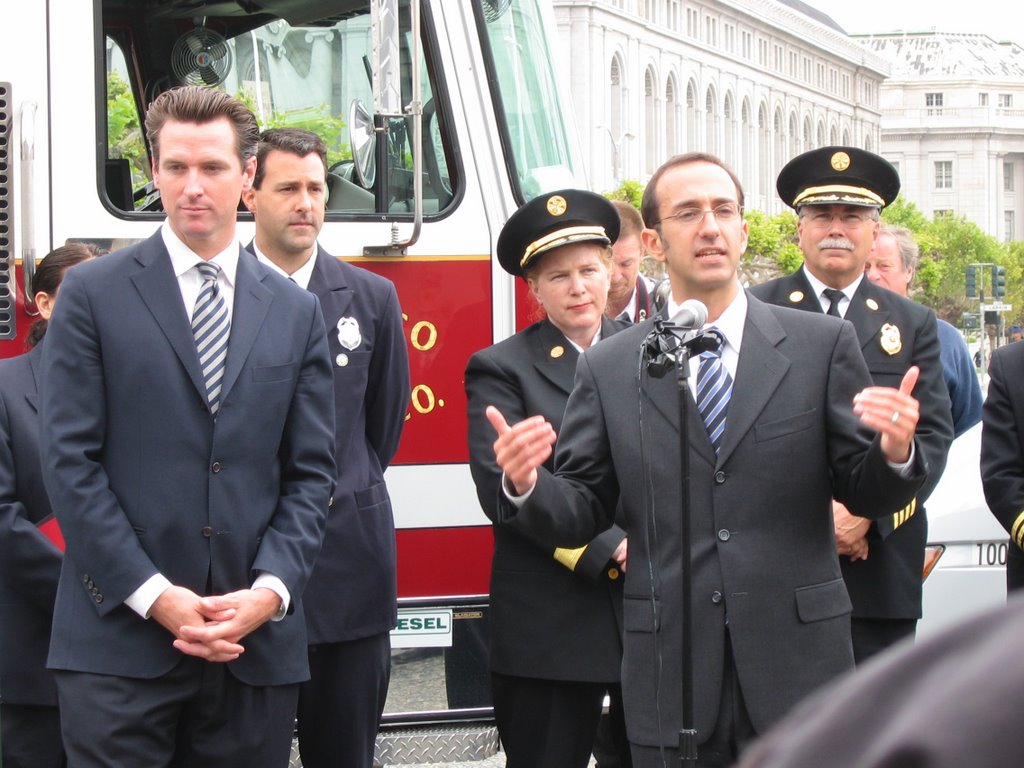 (Eric presenting to the crowd along with Mayor Gavin Newsom)
Mayor Gavin Newsom followed with his announcement of his Executive Order to move the entire City fleet to B20 by the end of 2007, making San Francisco the first major American City to make such a commitment.
These announcements were the culmination of a great deal of work by a number of people both inside City agencies and within the larger San Francisco biodiesel community. Brie Matthews and Mike Ferry spearheaded the effort at the Fire Department. Great photo of Brie in this story of the event. And members of the SF Biofuels Co-op have been working with the City on these and other biodiesel initiatives for over a year.
It was great to be part of this wonderful day and I look forward to continuing to work with the City of San Francisco to make this a successful program.
Written By: Eric Bowen
Saturday, April 15, 2006
To B2 OR NOT TO B2: musings on a blend specific RFS versus a volumetric RFS
Many of you have heard me express that I believe the biodiesel industry is supported by a two-legged stool of high petroleum prices and government support. You will also have likely heard me say that if one of those legs falls, the industry would likely contract, but would survive and that if both legs fell, the industry is dead.
There is not much one can do about the price of petroleum, so it is particularly important that biodiesel supporters get the government policy leg right. If the policies we advocate for end up too costly or onerous, we will risk losing these very policies. One of the key biodiesel policies being pursued is a patchwork of state biodiesel mandates or renewable fuel standards (RFS). Minnesota is the best-known example.
Minnesota’s legislature passed its B2 bill a few years ago, but the law only became effective last year when the trigger was satisfied. The bill requires that all diesel sold in Minnesota contain 2% biodiesel. I refer to this type of policy as a “blend specific RFS,” meaning that the blend itself is specified in the law, in Minnesota’s case 2% biodiesel or B2. Also worthy of note is the trigger Minnesota chose for when the requirement would take effect. Minnesota’s B2 bill was positioned primarily as an agricultural and rural economic development bill and accordingly the trigger that was chosen was that the state had enough biodiesel production capacity in state to satisfy the mandate. When two new 30 million gallon per year facilities came on line in Minnesota last year that threshold was crossed and the B2 requirement went into effect.
Contrary to the Minnesota blend specific model, the recently enacted (2005) Federal RFS, which includes both ethanol and biodiesel, is a volumetric requirement, meaning that no particular blend level is required, but rather, that the overall pool of fuel must contain at least a certain amount or volume of biofuel.
The second state to pass a biodiesel RFS was Washington State, which adopted a biodiesel and ethanol RFS earlier this year. Washington State’s biodiesel RFS was the result of a coalition of environmentalist and farmers. The bill began life as a Minnesota style B2 blend specific bill, but in the face of fierce opposition had to change to a Federal RFS style volumetric bill.
California now has a B2 biodiesel RFS winding its way through the legislative process. The bill is SB1675 (Kehoe) and is sponsored by Energy Independence Now. I have had the good fortune of working with the author, sponsor and other supports on the bill. Ever since I became aware of the bill, I have been trying to decide whether a blend specific or volumetric approach is preferable. I have consulted dozens of people in trying to answer this question and have come to the following conclusions.
Pros of B2 Mandate:
1) easy to monitor
2) gets renewable fuel into each gallon of diesel sold
3) provides a floor upon which to increase the percentage of renewable fuel in diesel
4) creates higher demand than an equivalent volumetric requirement (B20 and B100 market will continue to exist)
5) puts infrastructure in place for biodiesel blending at every terminal
6) no concern about increase in NOx
7) no engine warranty concerns
Cons of B2 Mandate:
1) difficult to implement - every terminal must be equipped to handle blending
2) will create lots of political opposition as all diesel users are hit (main concern is truckers and farmers)
3) higher implementation/transition costs as both low and high cost fuel providers and users are forced to make the switch
4) no significant air quality improvement
Pros of Volumetric:
1) harness power of market to maximize efficiencies and reduce cost of incorporating biodiesel into fuel mix
2) maximum flexibility for diesel users
3) encourages biodiesel to be used where it will have greatest environmental benefits (i.e. ports)
4) less political opposition from diesel users
Cons of Volumetric:
1) difficult to police
2) creates less demand for same % mandate (b/c existing and new B20 and B100 users likely included in mandate %)
3) potential for increased NOx emissions
4) potential for engine warranty issues
Depending on what hat I am wearing I come down on different sides of this debate.
When I am wearing my E2 hat, I lean toward the volumetric approach because of its flexibility and design to maximize the efficiencies of the marketplace. If a system to monitor and police the volumetric approach could be easily designed and implemented, I believe the volumetric approach would provide society with the greatest amount of renewable biodiesel at the least cost. A credit driven approach where excess credits can be freely traded, as with the Federal RFS, could be such a system. Layering a state-wide renewable fuel credit system on top of the Federal system would seem to create undue complication for fuel providers and as such I do not feel comfortable recommending such an option at this time.
When I am wearing my biodiesel industry hat, I lean towards the blend specific approach. It provides the greatest amount of certainty and would create the greatest amount of additional demand. It also creates an environment where all petroleum infrastructure is biodiesel ready and creates a low-blend baseline upon which to build.
Given the difficulty in designing a viable volumetric biodiesel RFS, I come down on the side of the B2 blend specific RFS. This provides the greatest increase in biodiesel use, vastly increasing the percentage of renewable fuel in the diesel fuel supply and reduces GHG emissions. The short-term transition costs to upgrade all petroleum facilities to handle biodiesel and blending of biodiesel is vastly outweighed by the benefits of biodiesel.
I encourage readers to come to their own conclusion and contribute to this discussion. Biodiesel and all of us who are believers in its potential will be better off as a result.
The other principal issue that comes up in designing a RFS is deciding on the trigger. As mentioned above, Minnesota chose in state production sufficient to met its mandate as its trigger. The Federal RFS chose time as its trigger, the volume of renewable fuel that must be in the total national fuel mix increase each year from 4 billion gallons in 2006 to 7.5 billion gallons in 2012.
What would be an appropriate trigger for California? Washington State chose a hybrid approach. The initial 2% volumetric requirement is timed based and becomes effective in 2008. The second phase trigger, where the volumetric requirement is increased from 2% to 5% is keyed to the production of in-state feedstocks equal to 3% of Washington State’s diesel consumption. This is rather different than Minnesota. Minnesota was already growing vast amounts of soybeans when it passed its RFS bill, but had very little biodiesel production. Accordingly, Minnesota in the name of rural economic development tied the implementation of its B2 mandate to in-state production.
Washington State on the other hand does not currently grow a significant amount of oil seed feedstocks. In order to gain the support of the farming community, the bill has to tie the second phase requirement to the growing of in-state feedstocks.
California is more like Washington State than Minnesota in that we do not currently grown a significant oil seed crop. I have proposed to the author and sponsor of SB 1675 that they consider both a Minnesota style in-state production trigger and a Washington State style in-sate feedstock growth trigger. I believe California industry and consumers can benefit from in-state production and that California agriculture can benefit from growing oil seed crops. Both of these should be explicitly encouraged in SB 1675.
Again, I encourage readers to come to their own conclusion and offer up their opinion on what triggers would be most appropriate for California. Feel free to offer any suggestion in the comment section of this blog or to email them to me directly at ericbowen@yahoo.com.
There is not much one can do about the price of petroleum, so it is particularly important that biodiesel supporters get the government policy leg right. If the policies we advocate for end up too costly or onerous, we will risk losing these very policies. One of the key biodiesel policies being pursued is a patchwork of state biodiesel mandates or renewable fuel standards (RFS). Minnesota is the best-known example.
Minnesota’s legislature passed its B2 bill a few years ago, but the law only became effective last year when the trigger was satisfied. The bill requires that all diesel sold in Minnesota contain 2% biodiesel. I refer to this type of policy as a “blend specific RFS,” meaning that the blend itself is specified in the law, in Minnesota’s case 2% biodiesel or B2. Also worthy of note is the trigger Minnesota chose for when the requirement would take effect. Minnesota’s B2 bill was positioned primarily as an agricultural and rural economic development bill and accordingly the trigger that was chosen was that the state had enough biodiesel production capacity in state to satisfy the mandate. When two new 30 million gallon per year facilities came on line in Minnesota last year that threshold was crossed and the B2 requirement went into effect.
Contrary to the Minnesota blend specific model, the recently enacted (2005) Federal RFS, which includes both ethanol and biodiesel, is a volumetric requirement, meaning that no particular blend level is required, but rather, that the overall pool of fuel must contain at least a certain amount or volume of biofuel.
The second state to pass a biodiesel RFS was Washington State, which adopted a biodiesel and ethanol RFS earlier this year. Washington State’s biodiesel RFS was the result of a coalition of environmentalist and farmers. The bill began life as a Minnesota style B2 blend specific bill, but in the face of fierce opposition had to change to a Federal RFS style volumetric bill.
California now has a B2 biodiesel RFS winding its way through the legislative process. The bill is SB1675 (Kehoe) and is sponsored by Energy Independence Now. I have had the good fortune of working with the author, sponsor and other supports on the bill. Ever since I became aware of the bill, I have been trying to decide whether a blend specific or volumetric approach is preferable. I have consulted dozens of people in trying to answer this question and have come to the following conclusions.
Pros of B2 Mandate:
1) easy to monitor
2) gets renewable fuel into each gallon of diesel sold
3) provides a floor upon which to increase the percentage of renewable fuel in diesel
4) creates higher demand than an equivalent volumetric requirement (B20 and B100 market will continue to exist)
5) puts infrastructure in place for biodiesel blending at every terminal
6) no concern about increase in NOx
7) no engine warranty concerns
Cons of B2 Mandate:
1) difficult to implement - every terminal must be equipped to handle blending
2) will create lots of political opposition as all diesel users are hit (main concern is truckers and farmers)
3) higher implementation/transition costs as both low and high cost fuel providers and users are forced to make the switch
4) no significant air quality improvement
Pros of Volumetric:
1) harness power of market to maximize efficiencies and reduce cost of incorporating biodiesel into fuel mix
2) maximum flexibility for diesel users
3) encourages biodiesel to be used where it will have greatest environmental benefits (i.e. ports)
4) less political opposition from diesel users
Cons of Volumetric:
1) difficult to police
2) creates less demand for same % mandate (b/c existing and new B20 and B100 users likely included in mandate %)
3) potential for increased NOx emissions
4) potential for engine warranty issues
Depending on what hat I am wearing I come down on different sides of this debate.
When I am wearing my E2 hat, I lean toward the volumetric approach because of its flexibility and design to maximize the efficiencies of the marketplace. If a system to monitor and police the volumetric approach could be easily designed and implemented, I believe the volumetric approach would provide society with the greatest amount of renewable biodiesel at the least cost. A credit driven approach where excess credits can be freely traded, as with the Federal RFS, could be such a system. Layering a state-wide renewable fuel credit system on top of the Federal system would seem to create undue complication for fuel providers and as such I do not feel comfortable recommending such an option at this time.
When I am wearing my biodiesel industry hat, I lean towards the blend specific approach. It provides the greatest amount of certainty and would create the greatest amount of additional demand. It also creates an environment where all petroleum infrastructure is biodiesel ready and creates a low-blend baseline upon which to build.
Given the difficulty in designing a viable volumetric biodiesel RFS, I come down on the side of the B2 blend specific RFS. This provides the greatest increase in biodiesel use, vastly increasing the percentage of renewable fuel in the diesel fuel supply and reduces GHG emissions. The short-term transition costs to upgrade all petroleum facilities to handle biodiesel and blending of biodiesel is vastly outweighed by the benefits of biodiesel.
I encourage readers to come to their own conclusion and contribute to this discussion. Biodiesel and all of us who are believers in its potential will be better off as a result.
The other principal issue that comes up in designing a RFS is deciding on the trigger. As mentioned above, Minnesota chose in state production sufficient to met its mandate as its trigger. The Federal RFS chose time as its trigger, the volume of renewable fuel that must be in the total national fuel mix increase each year from 4 billion gallons in 2006 to 7.5 billion gallons in 2012.
What would be an appropriate trigger for California? Washington State chose a hybrid approach. The initial 2% volumetric requirement is timed based and becomes effective in 2008. The second phase trigger, where the volumetric requirement is increased from 2% to 5% is keyed to the production of in-state feedstocks equal to 3% of Washington State’s diesel consumption. This is rather different than Minnesota. Minnesota was already growing vast amounts of soybeans when it passed its RFS bill, but had very little biodiesel production. Accordingly, Minnesota in the name of rural economic development tied the implementation of its B2 mandate to in-state production.
Washington State on the other hand does not currently grow a significant amount of oil seed feedstocks. In order to gain the support of the farming community, the bill has to tie the second phase requirement to the growing of in-state feedstocks.
California is more like Washington State than Minnesota in that we do not currently grown a significant oil seed crop. I have proposed to the author and sponsor of SB 1675 that they consider both a Minnesota style in-state production trigger and a Washington State style in-sate feedstock growth trigger. I believe California industry and consumers can benefit from in-state production and that California agriculture can benefit from growing oil seed crops. Both of these should be explicitly encouraged in SB 1675.
Again, I encourage readers to come to their own conclusion and offer up their opinion on what triggers would be most appropriate for California. Feel free to offer any suggestion in the comment section of this blog or to email them to me directly at ericbowen@yahoo.com.
Sunday, March 12, 2006
Sustainable Biodiesel Summit
I attended the Sustainable Biodiesel Summit (SBS) hosted by the Biodiesel Council of California in San Diego at the beginning of February. The Summit was a terrific event attended by over 200 people. The tone of the event was very positive regarding the opportunity for advancing a sustainable biodiesel industry. Lyle Estill of Piedmont Biofuels covered the Summit very well on his Energy Blog.
I gave a presentation at the SBS on Federal Incentives for biodiesel. Several members of the audience contributed to the presentation by providing real life examples of using the incentives in biodiesel projects they have been involved with. This added richness to the presentation and is the sort of dynamic that one only finds at community oriented events like the Sustainable Biodiesel Summit.
For those interested in the community and sustainable sides of the biodiesel industry, I highly recommend that you attend next year's Sustainable Biodiesel Summit, which will be held prior to the NBB's conference in San Antonio (2/4-7).
I gave a presentation at the SBS on Federal Incentives for biodiesel. Several members of the audience contributed to the presentation by providing real life examples of using the incentives in biodiesel projects they have been involved with. This added richness to the presentation and is the sort of dynamic that one only finds at community oriented events like the Sustainable Biodiesel Summit.
For those interested in the community and sustainable sides of the biodiesel industry, I highly recommend that you attend next year's Sustainable Biodiesel Summit, which will be held prior to the NBB's conference in San Antonio (2/4-7).
Friday, March 03, 2006
California Biodiesel Board Letter to the EPA
At the recent NBB conference in San Diego, a group of California biodiesel producers, users and advocates formed the California Biodiesel Board (CBB) to promote the use of biodiesel in California. Below you will find the CBB letter to the EPA regarding the need for the EPA to update its biodiesel NOx emissions data and requesting a scientifically based high credit value for biodiesel in the RFS regulations.
For all you regulatory nuts out there, enjoy!
Eric
***************
Stephen L. Johnson
Administrator, USEPA
US EPA Headquarters
Ariel Rios Building
1200 Pennsylvania Avenue, NW
Mail Code 1101A
Washington, DC 20460
March 3, 2006
RE: Biodiesel NOx Emissions and RFS Credits
Dear Administrator Johnson:
The California Biodiesel Board would like to thank you for your recent presentation at the National Biodiesel Board (NBB) Conference in San Diego. We appreciate your willingness to take time from your busy schedule to travel to California and inform the conference about EPA and the President’s commitment to replacing petroleum with renewable fuels.
Our members were in attendance at the conference, along with over 2000 other participants who want to increase biodiesel use in the United States. Our focus as the California Biodiesel Board is to educate Californian’s about biodiesel and to remove barriers, which impede its use.
We would like to have your help in increasing biodiesel use in California. There are two main ways you can help us:
1) EPA should evaluate new sources of biodiesel NOx data and establish a NOx emission rate that states can use in State Implementation Planning (SIP) - In 2003, EPA published a proposed regulation, which was a compilation of studies on biodiesel criteria pollutant emissions. EPA received very few comments on the regulation and, thus, did not issue a final regulation. In the proposed regulation, biodiesel NOx emission data was presented that claimed an increase over petro-diesel. Since that time, new NOx data has become available from sources such as the US Navy and NREL that demonstrates much lower NOx emissions for biodiesel. This important new NOx data has been presented in several public forums, including at the NBB conference. We respectfully request that EPA re-open the proposed regulation so that new NOx data can be submitted by interested parties and considered by EPA as you determine an emission rate for biodiesel NOx. In California, biodiesel NOx emission rates as presented by EPA (in the proposed regulation) are currently the primary barrier to CARB’s acceptance of biodiesel.
2) US EPA should consider the technical data on the total life cycle analysis of ethanol verses biodiesel and the BTU loss in using ethanol verses biodiesel to replace petroleum fuels when establishing a credit for biodiesel in the renewable fuel regulations; EPA should base the biodiesel credit number on science, not politics. In the fall of 2006, EPA plans to propose regulations that will establish the credit value for biodiesel and the credit-trading program rules for all renewable fuels. The credit value for biodiesel and the credit-trading program will have an enormous impact on the biodiesel industry. It is imperative that the rules be established in a fair and scientific way. We understand that EPA is under strong political pressure to favor ethanol in this process. Based on several technically sound methods, biodiesel should receive a credit of no less than 3 to 1 as compared to ethanol. We further understand that EPA is considering a number less than two for biodiesel. A low credit value for biodiesel is advocated by the ethanol industry for obvious reasons. Unfortunately, the dynamics of the NBB have prohibited the NBB from being able to oppose a low credit value for biodiesel. This dynamic exists because many of NBB’s members have ethanol interests. The California Biodiesel Board respectfully requests that EPA consider only the scientific and technical information, and not politics, as you make this important choice. The biodiesel credit value will greatly affect the growth of biodiesel in California and the rest of the US. Furthermore, and of equal if not greater importance, the methods used to determine such credit value will set a crucial precedent for how renewable fuels will be evaluated in the future.
The California Biodiesel Board will be glad to answer any questions you have regarding our requests. Again, please let us thank you for your support of biodiesel.
Sincerely,
Eric M. Bowen
Acting Chairman
California Biodiesel Board
CC: Margo Oge, USEPA, Office of Transportation and Air Quality
For all you regulatory nuts out there, enjoy!
Eric
***************
Stephen L. Johnson
Administrator, USEPA
US EPA Headquarters
Ariel Rios Building
1200 Pennsylvania Avenue, NW
Mail Code 1101A
Washington, DC 20460
March 3, 2006
RE: Biodiesel NOx Emissions and RFS Credits
Dear Administrator Johnson:
The California Biodiesel Board would like to thank you for your recent presentation at the National Biodiesel Board (NBB) Conference in San Diego. We appreciate your willingness to take time from your busy schedule to travel to California and inform the conference about EPA and the President’s commitment to replacing petroleum with renewable fuels.
Our members were in attendance at the conference, along with over 2000 other participants who want to increase biodiesel use in the United States. Our focus as the California Biodiesel Board is to educate Californian’s about biodiesel and to remove barriers, which impede its use.
We would like to have your help in increasing biodiesel use in California. There are two main ways you can help us:
1) EPA should evaluate new sources of biodiesel NOx data and establish a NOx emission rate that states can use in State Implementation Planning (SIP) - In 2003, EPA published a proposed regulation, which was a compilation of studies on biodiesel criteria pollutant emissions. EPA received very few comments on the regulation and, thus, did not issue a final regulation. In the proposed regulation, biodiesel NOx emission data was presented that claimed an increase over petro-diesel. Since that time, new NOx data has become available from sources such as the US Navy and NREL that demonstrates much lower NOx emissions for biodiesel. This important new NOx data has been presented in several public forums, including at the NBB conference. We respectfully request that EPA re-open the proposed regulation so that new NOx data can be submitted by interested parties and considered by EPA as you determine an emission rate for biodiesel NOx. In California, biodiesel NOx emission rates as presented by EPA (in the proposed regulation) are currently the primary barrier to CARB’s acceptance of biodiesel.
2) US EPA should consider the technical data on the total life cycle analysis of ethanol verses biodiesel and the BTU loss in using ethanol verses biodiesel to replace petroleum fuels when establishing a credit for biodiesel in the renewable fuel regulations; EPA should base the biodiesel credit number on science, not politics. In the fall of 2006, EPA plans to propose regulations that will establish the credit value for biodiesel and the credit-trading program rules for all renewable fuels. The credit value for biodiesel and the credit-trading program will have an enormous impact on the biodiesel industry. It is imperative that the rules be established in a fair and scientific way. We understand that EPA is under strong political pressure to favor ethanol in this process. Based on several technically sound methods, biodiesel should receive a credit of no less than 3 to 1 as compared to ethanol. We further understand that EPA is considering a number less than two for biodiesel. A low credit value for biodiesel is advocated by the ethanol industry for obvious reasons. Unfortunately, the dynamics of the NBB have prohibited the NBB from being able to oppose a low credit value for biodiesel. This dynamic exists because many of NBB’s members have ethanol interests. The California Biodiesel Board respectfully requests that EPA consider only the scientific and technical information, and not politics, as you make this important choice. The biodiesel credit value will greatly affect the growth of biodiesel in California and the rest of the US. Furthermore, and of equal if not greater importance, the methods used to determine such credit value will set a crucial precedent for how renewable fuels will be evaluated in the future.
The California Biodiesel Board will be glad to answer any questions you have regarding our requests. Again, please let us thank you for your support of biodiesel.
Sincerely,
Eric M. Bowen
Acting Chairman
California Biodiesel Board
CC: Margo Oge, USEPA, Office of Transportation and Air Quality
Tuesday, January 31, 2006
Looking Behind; Looking Ahead
Is it really the end of January already? Time in biodiesel land seems to by flying by. 2005 was a breakout year for biodiesel and 2006 is set to prove even more important as the industry manages it first real growth spurt.
In the tradition of year-end reviews, here is my list of 2005 biodiesel highlights.
2005 would not have been “2005” without the biodiesel blender credits, which were passed at the end of 2004 and became effective January 1, 2005. As regular readers of All Things Biodiesel will surely know, those credits provide a $1.00 per gallon Federal Excise Tax credit for virgin biodiesel and 50 cent per gallon credit for recycled biodiesel. These credits signaled to the biodiesel market that the price difference between petroleum diesel and biodiesel was about to shrink substantially and that the Federal government was firmly in biodiesel’s corner.
The second big trend of 2005, which was only possible because of the blender’s credit, was the entrance of Big-Ag into the biodiesel market. Cargill announced plans to build a 37 million gallon per year facility in Iowa and ADM announced plans to build 50 million gallon per year facility in North Dakota. With Big-Ag making a significant move into biodiesel, the landscape changed in a few key ways. First, biodiesel has begun its move from a niche fuel to a mainstream fuel additive. Second, the risk of Federal subsidies not being renewed has significantly diminished. Big-Ag has a lot of influence on the hill and will surely now use that influence to protect its investment in biodiesel.
For those of us who like the community aspects of biodiesel, the entrance of Big-Ag is a mixed bag. On the negative side, Big-Ag biodiesel makes community scale biodiesel more challenging. If and when we see a biodiesel supply glut, Big-Ag will flood the market with cheap biodiesel. It will want to maintain and/or expand its market share and will be able to operate with little to no margin because of its extensive non-biodiesel revenue sources. On the positive side, Big-Ag will undoubtedly bring more professionalism, stability and innovation to biodiesel, as the presence of Big-Ag attracts new entrants into the biodiesel marketplace.
The third big event/trend of 2005 was the price of petroleum. Sustained high petroleum prices had a number of beneficial effects. First, as the American consumer felt the bite of higher prices at the pump, alternative fuels like biodiesel, which hold the promise of lower prices over the long term, became the darling of the press. Second, as the price difference between biodiesel and petroleum diesel shrunk, more fleets felt comfortable about making the plunge into biodiesel. Similarly, that same shrinking price differential, when combined with government incentives, made biodiesel less expensive than petroleum diesel in certain markets, most notably Illinois, which became America’s “biodiesel sponge” in 2005.
Katrina proved to be another catalyzing event for biodiesel in 2005. Katrina reinforced the trends outlined above regarding high petroleum prices, as Katrina caused a significant petrol price spike. Katrina briefly caused biodiesel “price inversion” (B100 less expensive the diesel #2) in several markets, including the Pacific Northwest. Katrina also highlighted America’s dependence on petroleum and gave fuel diversification policies a much needed shot in the arm.
Along similar lines, the emergence of James Woolsey and other national security hawks onto the scene, provided Americans and their policy makers with another good reason to support biodiesel: reducing America’s dependence on foreign oil. While this benefit of biodiesel has been expounded upon for years by farmers and environmentalists, it took a conservative Republican like Mr. Woolsey to give the argument credibility with his follow conservatives and the press.
There are many other important events and trends that warrant mention: commercialization of algae to biodiesel by GreenFuel Technologies and Greenshift Corporation; the huge spike in biofuel and biodiesel conferences, a sure sign of froth in the market; seasonality in biodiesel demand, which seems to be the result of farmers using substantially less biodiesel in November as work in the fields comes to a close and less consumption in the upper mid-west and north-east as winter approaches; and the passage of the Energy Bill, which created a Federal renewable fuel standard.
So what does it all mean? Only time will tell, but here are my thoughts on some key trends to watch in 2006.
Palm biodiesel will be an increasingly big story in 2006. The economics of palm biodiesel compared with soy biodiesel have excited many and have compelled others into investigating its potential in the U.S. As one would expect, this has not won the favor of America’s soybean growers, who have to date, had close to a monopoly on U.S. biodiesel production. Rest assured that the American Soybean Association will do everything in its power to restrict palm biodiesel’s access to the biodiesel tax credits. But as the biodiesel industry develops on the coasts, those developers will be looking closely at palm as an abundant source of low-cost feedstock. The cold flow properties of palm biodiesel will need to be worked out, but many smart minds are currently working to solve that problem.
Many states are looking to follow Minnesota’s lead and enact B2 or other low blend requirements. Washington State is currently actively debating several such proposals working their way through Olympia. Many eyes are on Washington State and if they are successful, I would expect to see several more states follow their lead. On the other hand, if they are unsuccessful, opponents of low blend mandates will feel emboldened and will have the upper hand in fighting such proposals on other states. This battle will take place against the backdrop of Minnesota’s great difficulty in implementing its B2 mandate.
Tens of million of biodiesel production will be coming online for the first time in 2006. Many new biodiesel consumers are coming online as well. Will demand increase enough to match the increase in supply? I optimistically believe so, but I also believe we will see surplus in some markets. Given the cost of transporting biodiesel, I think the market will be increasingly regional compared with the past, when mid-western biodiesel producers shipped biodiesel to the rest of the country.
The implementation of ultra-low-sulfur diesel in 2006 has the potential to be the most important source of growth the biodiesel the industry has ever seen. On the other hand, it is far from certain that biodiesel will be chosen lubricity additive.
It will undoubtedly be an exciting year for biodiesel. I look forward to seeing many of you and next week’s NBB conference and continuing the biodiesel conversation.
Eric
In the tradition of year-end reviews, here is my list of 2005 biodiesel highlights.
2005 would not have been “2005” without the biodiesel blender credits, which were passed at the end of 2004 and became effective January 1, 2005. As regular readers of All Things Biodiesel will surely know, those credits provide a $1.00 per gallon Federal Excise Tax credit for virgin biodiesel and 50 cent per gallon credit for recycled biodiesel. These credits signaled to the biodiesel market that the price difference between petroleum diesel and biodiesel was about to shrink substantially and that the Federal government was firmly in biodiesel’s corner.
The second big trend of 2005, which was only possible because of the blender’s credit, was the entrance of Big-Ag into the biodiesel market. Cargill announced plans to build a 37 million gallon per year facility in Iowa and ADM announced plans to build 50 million gallon per year facility in North Dakota. With Big-Ag making a significant move into biodiesel, the landscape changed in a few key ways. First, biodiesel has begun its move from a niche fuel to a mainstream fuel additive. Second, the risk of Federal subsidies not being renewed has significantly diminished. Big-Ag has a lot of influence on the hill and will surely now use that influence to protect its investment in biodiesel.
For those of us who like the community aspects of biodiesel, the entrance of Big-Ag is a mixed bag. On the negative side, Big-Ag biodiesel makes community scale biodiesel more challenging. If and when we see a biodiesel supply glut, Big-Ag will flood the market with cheap biodiesel. It will want to maintain and/or expand its market share and will be able to operate with little to no margin because of its extensive non-biodiesel revenue sources. On the positive side, Big-Ag will undoubtedly bring more professionalism, stability and innovation to biodiesel, as the presence of Big-Ag attracts new entrants into the biodiesel marketplace.
The third big event/trend of 2005 was the price of petroleum. Sustained high petroleum prices had a number of beneficial effects. First, as the American consumer felt the bite of higher prices at the pump, alternative fuels like biodiesel, which hold the promise of lower prices over the long term, became the darling of the press. Second, as the price difference between biodiesel and petroleum diesel shrunk, more fleets felt comfortable about making the plunge into biodiesel. Similarly, that same shrinking price differential, when combined with government incentives, made biodiesel less expensive than petroleum diesel in certain markets, most notably Illinois, which became America’s “biodiesel sponge” in 2005.
Katrina proved to be another catalyzing event for biodiesel in 2005. Katrina reinforced the trends outlined above regarding high petroleum prices, as Katrina caused a significant petrol price spike. Katrina briefly caused biodiesel “price inversion” (B100 less expensive the diesel #2) in several markets, including the Pacific Northwest. Katrina also highlighted America’s dependence on petroleum and gave fuel diversification policies a much needed shot in the arm.
Along similar lines, the emergence of James Woolsey and other national security hawks onto the scene, provided Americans and their policy makers with another good reason to support biodiesel: reducing America’s dependence on foreign oil. While this benefit of biodiesel has been expounded upon for years by farmers and environmentalists, it took a conservative Republican like Mr. Woolsey to give the argument credibility with his follow conservatives and the press.
There are many other important events and trends that warrant mention: commercialization of algae to biodiesel by GreenFuel Technologies and Greenshift Corporation; the huge spike in biofuel and biodiesel conferences, a sure sign of froth in the market; seasonality in biodiesel demand, which seems to be the result of farmers using substantially less biodiesel in November as work in the fields comes to a close and less consumption in the upper mid-west and north-east as winter approaches; and the passage of the Energy Bill, which created a Federal renewable fuel standard.
So what does it all mean? Only time will tell, but here are my thoughts on some key trends to watch in 2006.
Palm biodiesel will be an increasingly big story in 2006. The economics of palm biodiesel compared with soy biodiesel have excited many and have compelled others into investigating its potential in the U.S. As one would expect, this has not won the favor of America’s soybean growers, who have to date, had close to a monopoly on U.S. biodiesel production. Rest assured that the American Soybean Association will do everything in its power to restrict palm biodiesel’s access to the biodiesel tax credits. But as the biodiesel industry develops on the coasts, those developers will be looking closely at palm as an abundant source of low-cost feedstock. The cold flow properties of palm biodiesel will need to be worked out, but many smart minds are currently working to solve that problem.
Many states are looking to follow Minnesota’s lead and enact B2 or other low blend requirements. Washington State is currently actively debating several such proposals working their way through Olympia. Many eyes are on Washington State and if they are successful, I would expect to see several more states follow their lead. On the other hand, if they are unsuccessful, opponents of low blend mandates will feel emboldened and will have the upper hand in fighting such proposals on other states. This battle will take place against the backdrop of Minnesota’s great difficulty in implementing its B2 mandate.
Tens of million of biodiesel production will be coming online for the first time in 2006. Many new biodiesel consumers are coming online as well. Will demand increase enough to match the increase in supply? I optimistically believe so, but I also believe we will see surplus in some markets. Given the cost of transporting biodiesel, I think the market will be increasingly regional compared with the past, when mid-western biodiesel producers shipped biodiesel to the rest of the country.
The implementation of ultra-low-sulfur diesel in 2006 has the potential to be the most important source of growth the biodiesel the industry has ever seen. On the other hand, it is far from certain that biodiesel will be chosen lubricity additive.
It will undoubtedly be an exciting year for biodiesel. I look forward to seeing many of you and next week’s NBB conference and continuing the biodiesel conversation.
Eric
Tuesday, November 29, 2005
San Francisco City Government Takes A Step Closer To Using Biodiesel: Lessons From Municipal Biodiesel Contracting
I have been a biodiesel advocate for a number of years now. I would characterize myself as one of those who could not understand why more fleets, and why more government fleets in particular, were not switching to biodiesel blends. I generally attributed it to one of two things, price or institutional resistance to change. Price is still an issue in some markets, like Northern California, but has been eliminated, or at least reduced, as an issue in other markets.
I have been working with the City of San Francisco the past few months on their fuel purchasing contract. The City is incorporating biodiesel into the fuel contract for the first time. Here is a link to the contract.
This experience has forced me to revisit my thoughts about institutional resistance to change. MUNI, San Francisco's public transportation agency, has a particularly challenging environment. MUNI consumes around 6 million gallons of diesel fuel each year. They have several yards, each with their own fuel tanks. Buses can start any given day at one yard and end the day in another. So the idea of starting some buses on biodiesel is impractical, as it is very difficult to know where any given bus will be on any given day.
Further complicating matters, MUNI has a policy that all fuel tanks must be at least 75% full at all times. This is San Francisco after all and we do have earthquakes, so the City must be prepared at all times with reserve fuel. This policy has a few implications. First, in the ideal world, you would empty and clean a tank prior to switching over to biodiesel. If you have to maintain the tank at least 75% full at all times, you can never empty and clean a tank. Second, biodiesel is still a young industry. Supply is not consistent enough to guarantee that you will be able to maintain tanks at least 75% full at all times. Accordingly, provision must be made to supplement with diesel when biodiesel is not available as delivery must be made every day to maintain the required fuel level.
The largest tank farm is comprised of four 20,000 gallon below ground tanks. These four tanks are interconnected, creating in essence one 80,000 gallon tank. It is very likely that the tank contains sediment. Cleaning out the sediment prior to switching to biodiesel will obviously be a challenge. Doable, but a challenge.
Then there is the topic of politics. I will grant you that San Francisco is a more political City than most, but I believe the lessons learned here are generally applicable elsewhere. The push to use biodiesel has been both a bottom-up and a top-down phenomenon. From the bottom-up have been the people running the alternative fuels program and the local biodiesel community. From the top-down have been the Mayor and his Department of the Environment. What has been missing is support from those on the front line, the fuel managers, mechanics, drivers and their immediate bosses. Without the support of these front line implementers, biodiesel will go nowhere. I have learned that taking the time to educate everyone involved is essential and that one should start early. City agencies will fight tooth and nail if they are not consulted early and often. They need to feel ownership of the program. The goal of these front line employees is to keep the buses running after all, not to clean them up. That is the job of the biodiesel advocates and the politicians who support them. Our job is to bring the front line employees to our side, patiently and respectfully. Biodiesel is a great fuel after all, but that does not mean that you can short-cut the process of change that switching to biodiesel represents. While biodiesel is a "drop-in" fuel, the reality on the ground when mananging large fleets is that every precaution must be taken.
The Fire Department, MUNI, the Parks Department and the Zoo have all expressed interest in using biodiesel. Now that the City's fuel contract will include biodiesel procurement for the first time, they should be able to begin their pilot programs and eventually move to more widespread biodiesel use. They will likely start with B20 and increase the percentage in the blend over time. Another exciting biodiesel journey has begun.
If anyone feels like responding to the City's biodiesel fuel contract, please let me know. We are working hard to ensure that several quality biodiesel bids come in.
Thursday, November 10, 2005
Platts Conference Part II
Here are the rest of the presentations given at Platts.
http://www.platts.com/Events/PB540X/presentations_index.html
http://www.platts.com/Events/PB540X/presentations_index.html
Sunday, November 06, 2005
Platts Biodiesel Investor Conference, Chicago
I just returned from the Platts Biodiesel Investor Conference in Chicago. It was a good conference, informative presentations and many good people in attendance. My presentation on biodiesel incentives can be found here. The slides from the other presenters will be made available soon and when they are I will post the link in a follow-up piece.
A few observations coming out of the conference:
First, biodiesel still is and will be for the next couple of years a soy oil play. All the talk of alternative feedstocks (broadly defined for this purpose as anything other than soy or canola/rape) is encouraging, but such feedstocks will have a limited roll in the US biodiesel industry in the near term. Animal fats will have a roll to play, but the technology for converting these feedstocks to consistent high quality biodiesel is still fairly new, which is resulting in smaller plant sizes (1-5 mgpy) compared to the new virgin oil plants (30-50 mpgy). Accordingly, virgin oil biodiesel will continue to dominate in the marketplace. Well designed and thought out animal fat biodiesel plants should be able to survive in this environment, but need to have a strategy to survive in the industry long term as the trend towards larger plants continues. Imported oils such as palm may also have a roll to play, but their roll in the near term is fairly limited.
Second, there is lots of excitement in the biodiesel industry, but business models still need sharpening. I met many eager biodiesel developers, folks with plants currently in the early stages of development. I wish each of these folks well, but my working hypothesis that most of these plants will never get built remains. The risk has not been sufficiently taken out of these deals to attract serious investors. A few of these folks will get there with the right guidance, but sadly, I fear that many will not make the long slog from conception to production.
Third, the trend of power plant developers getting interested in biodiesel continues. These folks are looking to transfer their power project development expertise into the biodiesel industry. This should benefit the industry as it continues to professionalize and grow beyond its agriculture and rendering/WVO roots. The big question that comes along with this phenomenon is how sustainable is an independant biodiesel producer. If petroleum prices remain high and government support for biodiesel remains strong, I believe the independent biodiesel producers can thrive. On the other hand, should the price of oil drop below $35 or $40 dollars a barrel and/or government support for biodiesel falter, the independent biodiesel producer could quickly find themselves in troubled waters.
Fourth, if the three most important factors in the restaurant business are location, location, location, then the three most important factors in the biodiesel business are quality, quality, and quality. This is not new, but is worthy of note because it has several implications. (More on that later. Out of time at the moment. Sorry.)
A few observations coming out of the conference:
First, biodiesel still is and will be for the next couple of years a soy oil play. All the talk of alternative feedstocks (broadly defined for this purpose as anything other than soy or canola/rape) is encouraging, but such feedstocks will have a limited roll in the US biodiesel industry in the near term. Animal fats will have a roll to play, but the technology for converting these feedstocks to consistent high quality biodiesel is still fairly new, which is resulting in smaller plant sizes (1-5 mgpy) compared to the new virgin oil plants (30-50 mpgy). Accordingly, virgin oil biodiesel will continue to dominate in the marketplace. Well designed and thought out animal fat biodiesel plants should be able to survive in this environment, but need to have a strategy to survive in the industry long term as the trend towards larger plants continues. Imported oils such as palm may also have a roll to play, but their roll in the near term is fairly limited.
Second, there is lots of excitement in the biodiesel industry, but business models still need sharpening. I met many eager biodiesel developers, folks with plants currently in the early stages of development. I wish each of these folks well, but my working hypothesis that most of these plants will never get built remains. The risk has not been sufficiently taken out of these deals to attract serious investors. A few of these folks will get there with the right guidance, but sadly, I fear that many will not make the long slog from conception to production.
Third, the trend of power plant developers getting interested in biodiesel continues. These folks are looking to transfer their power project development expertise into the biodiesel industry. This should benefit the industry as it continues to professionalize and grow beyond its agriculture and rendering/WVO roots. The big question that comes along with this phenomenon is how sustainable is an independant biodiesel producer. If petroleum prices remain high and government support for biodiesel remains strong, I believe the independent biodiesel producers can thrive. On the other hand, should the price of oil drop below $35 or $40 dollars a barrel and/or government support for biodiesel falter, the independent biodiesel producer could quickly find themselves in troubled waters.
Fourth, if the three most important factors in the restaurant business are location, location, location, then the three most important factors in the biodiesel business are quality, quality, and quality. This is not new, but is worthy of note because it has several implications. (More on that later. Out of time at the moment. Sorry.)
Thursday, October 13, 2005
The Reality of B100 Pricing in Northern California
As President of the San Francisco Biofuels Co-op, I am often asked, why is the price of biodiesel so high and why have prices stayed high after the introduction of the federal excise tax credits.
The short answer is supply and demand. Demand for biodiesel has increased greatly over the last year. Supply, while increasing rapidly, has not increased rapidly enough to keep up with demand. Northern California fits this profile, but has the added complication of lack of local production. All of our biodiesel has to be brought in via truck or railcar, which further increases the price.
Here is the current pricing breakdown:
SFBC Fuel Pricing
Wholesale Price to Our Local B99.9 Fuel Distributor $ 2.855
California Diesel Fuel Tax $ 0.180
California Sales Tax (8.5% of price not including CA diesel fuel tax) $ 0.291
Federal Excise Tax $ 0.244
Less, IRS Tax Credit $ (0.500)
Total $ 3.070
Price to SF Biofuels $ 3.450
Distributors Margin $ 0.380
SF Biofuels Mark-up $ 0.150
Sweat Equity Price $ 3.600
SF Biofuels additional Non-sweat equity mark-up $ 0.250
Non-Sweat Price $ 3.850
The short answer is supply and demand. Demand for biodiesel has increased greatly over the last year. Supply, while increasing rapidly, has not increased rapidly enough to keep up with demand. Northern California fits this profile, but has the added complication of lack of local production. All of our biodiesel has to be brought in via truck or railcar, which further increases the price.
Here is the current pricing breakdown:
SFBC Fuel Pricing
Wholesale Price to Our Local B99.9 Fuel Distributor $ 2.855
California Diesel Fuel Tax $ 0.180
California Sales Tax (8.5% of price not including CA diesel fuel tax) $ 0.291
Federal Excise Tax $ 0.244
Less, IRS Tax Credit $ (0.500)
Total $ 3.070
Price to SF Biofuels $ 3.450
Distributors Margin $ 0.380
SF Biofuels Mark-up $ 0.150
Sweat Equity Price $ 3.600
SF Biofuels additional Non-sweat equity mark-up $ 0.250
Non-Sweat Price $ 3.850
Friday, October 07, 2005
CCC Bioenergy Program Credits
I see a lot of biodiesel business plans and unfortunately far too many of them are still including the CCC credits in their financial models. In the interest of clearing things up, here is the lowdown on the disappearing CCC credits.
The following is a recent press release I put out on the topic. Following the press release is more background on the CCC program.
BIODIESEL CCC CREDITS DISAPPEARING:
Sigma Capital Rings Alarm on Potential Disruption to Biodiesel Industry.
The Commodity Credit Corporation (CCC) Bioenergy Program has been a key enabling factor for the infant biodiesel industry. The CCC biofuels program has provided up to $0.90 per gallon to biodiesel producers recently. These CCC funds are likely to shrink substantially this year and are scheduled to disappear altogether at the end of the 2006 Federal fiscal year (August 31, 2006). The loss of this financial support from the Federal government could have devastating effects for the biodiesel industry, just as the industry is gaining momentum.
The funding available for the Bioenergy Program for 2006 fiscal year (which began Sept.1st) could be as little as $25.5 million, a dramatic reduction from previous years. In the 2003 and 2004, the Bioenergy Program provided $150 million to the biodiesel and ethanol industries to reduce the cost of feedstock. In the 2005 fiscal year, the program provided $100 million. The appropriation for the 2006 fiscal year has not been finalized, but will likely be between $60 million and $100 million. Unfortunately, the program ran up a $34.5 million deficit in prior years and this deficit will need to be repaid from the 2006 fiscal year appropriation. In other words, if the appropriation is $60 million, after the $34.5 million deficit is repaid, only $25.5 million will be available for all of the 2006 fiscal year.
To make matters worse, the program expires at the end of the 2006 fiscal year. This vast reduction in the amount of money available coincides with the greatest growth the biodiesel industry has ever seen in the United States creating a perfect storm: increased claims, lower appropriation, and a program deficit, all of which will contribute to greatly reduced payments to biodiesel producers.
But wait a minute you say, what about the biodiesel excise tax credits, which provide for up to $1.00 per gallon? Good question, but unfortunately, those credits are only available to a biodiesel “blender,” which in the majority of cases, is the petroleum company distributing the biodiesel. Accordingly, the biodiesel producers are not seeing any direct benefit from these credits.
The loss of the CCC Bioenergy Program payments may seem okay now, with diesel prices at historic highs. But if diesel prices come down, as is likely, biodiesel producers could quickly find themselves in a financial crunch as feedstock costs continue to rise and biodiesel excise tax credits are absorbed by petroleum distributors. Blenders, with little risk, are getting the full benefit of the biodiesel excise tax credits, while producers, with large capital investments and long paybacks, are shouldering all the risk.
“We are very concerned about the loss of this important revenue stream” said Eric Bowen, Sigma Capital’s Vice President, Energy and Director, Biofuels. “The CCC Bioenergy Program has been the principal Federal program directly benefiting biodiesel producers. The loss of the CCC Bioenergy Program has the potential to have a significant adverse impact on the supply of biodiesel in the United States and will make financing new biodiesel plants more difficult".
“If you are an existing biodiesel producer and your business model is dependant on the CCC credit, we would recommend you develop alternatives to offset this potential loss of credit with new revenue sources or cost reductions ” said Bruce Woodry, Sigma Capital’s CEO. Mr. Woodry continued “As a result of the disappearing CCC Bioenergy credits, sharpened business models and astute financial structuring for proposed biodiesel plants will assure investment grade returns are delivered and funding can be raised in this highly competitive financial marketplace.”
“Catastrophes like Katrina highlight the value and importance of a diversified fuel source, and programs such as the CCC Bioenergy Program are instrumental in creating a level playing field for new entrants. The CCC Bioenergy Program enables biodiesel to come to market at a reasonable price point regardless of the price of petroleum. This in turn assures fuel availability and price stability by have a choice of fuels at the pump should there be a price spike or supply disruption in traditional petroleum fuels” said Anna Halpern-Lande, Principal, Cyrnel, LLC, a California based biodiesel consulting company.
About Cyrnel, LLC:
Cyrnel, LLC is a consulting firm specializing in go-to-market and market development strategies and execution for renewable energy and clean technology companies. For more information, please contact Anna Halpern-Lande, Telephone: (916) 265-0206, Email: anna@cyrnel.com or Web: www.cyrnel.com.
About Sigma Capital:
Sigma Capital Group is a ten-year-old boutique investment bank located in Raleigh, North Carolina, adjacent to Research Triangle Park that has built a strong reputation for improving shareholder value through corporate development activities. Sigma Capital Group provides advisory and representational services to clients in the Energy, Real Estate/Destination Resorts, Telecommunications & Information Technology sectors with transaction values in the $5M to $200M range.
***
Here is some additional information for those desiring more background on the CCC program.
Commodity Credit Corporation Payments
The Bioenergy Program was adopted to help expand industrial consumption of agricultural commodities by promoting their use in the production of biofuels. As such, payments are based on input commodity prices rather than biodiesel output prices. The program began in 2001 as a two-year program, and was extended through 2006 in the 2002 Farm Bill. It is not clear as of this time if the program will be extended beyond the end of 2006. The National Biodiesel Board has made extending the Bioenergy Program a top priority.
Program payments for biodiesel producers have historically been divided into two sections, payments for base biodiesel production (base equals the prior year's production) and payments for increased production (production beyond last year's production). Beginning with the 2006 fiscal year (October 1, 2005), payments for base biodiesel production are no longer available.
The maximum amount of money that may be disbursed through the Bioenergy Program in any given year is $150 million. The $150 million is shared by both the biodiesel and ethanol industry.
$150 million was appropriated for each of the 2003 and 2004 fiscal years. $100 million was appropriated for the 2005 fiscal year. Appropriation for the 2006 fiscal year will not occur until later this year, likely November. The Bioenergy appropriation is part of the larger agriculture appropriation. CCC staff believes that the 2006 appropriation could be as little as $60 million and that it is unlikely to be greater than $100 million. To make matters worse, the 2006 appropriation will have to cover a deficit of $34.5 million from prior years. Accordingly, if $60 million were appropriated, after subtracting the $34.5 million deficit, only $25.5 million would be available for the 2006 fiscal year.
A biodiesel producer must apply in August of the prior year to qualify for payments in the current fiscal year. Accordingly, a new producer can only qualify for the 2006 fiscal year if they applied in August of this year. No new applications can be made.
Program payments for biodiesel are calculated as follows: the number of gallons of increased production is divided by 1.4, the result of which is divided by the feedstock conversion factor (2.5 for a bushel of soybean), the result of which is multiplied by the USDA posted county price for the commodity. For example, 1 gal. of increased production of soybean biodiesel would be calculated as follows:
1 / 1.4 / 2.5 * $6.20 (soybean bushel price) = $1.77143
According to Bob Brown at the CCC, the credit for recycled cooking oil, yellow grease and animal fat feedstocks is equal to approximately 40% to 65% of the soy oil payments, or $0.71 to $1.15 based on the above example. The CCC calculates the percentage as follows (San Joaquin Valley yellow grease example): Jacobson yellow grease price (San Joaquin Valley) $0.145 / $0.2592 (price of soy oil - USDA crush report) equals 55.9%.
For the last several years of the program, there have been more biodiesel and ethanol producers applying for the credit than funds available. Accordingly, payments for all program participants are pro-rated. The pro-ration for the second quarter of 2005 was 50.1% and the pro-ration for the first quarter of 2005 was 39.6%. Accordingly, for the soybean example above, the second quarter of 2005 per gallon payment would be reduced from $1.77143 to $0.88749.
The value of the CCC credits will almost certainly be substantially less in 2006 as a result of significantly less money being available in the program (as little as $25.5 million versus 2005’s $100 million), and the large amount of additional ethanol and biodiesel capacity coming online, both of which will resulting in increased pro-ration.
As previously stated, without an extension, the program terminates at the end of the 2006 fiscal year, August 31, 2006.
Wednesday, October 05, 2005
The Importance of ADM’s Formal Entrance into the United States Biodiesel Market
As I have written elsewhere, the US biodiesel industry is going through its first sea change. The industry has largely been characterized to date by smaller production facilities built on custom technology. The typical biodiesel plant was owned by soybean farmers and built on first of its kind biodiesel processor technology. With the introduction of excise tax credits in the 2004 JOBS Bill, and the persistent high price of petroleum, the biodiesel industry has seen a lot of interest recently. Private investors and larger public companies are investing in biodiesel plants, which is pushing the industry towards larger production facilities built on the best technologies available from outside companies. ADM's announcement of its plans to build a 50 million gallon per year biodiesel production facility in North Dakota (http://www.admworld.com/naen/pressroom/) is further evidence of this trend.
In order to be successful in today's biodiesel industry, great care must be taken to select appropriate biodiesel processor technology and to secure a source of reliable and reasonably priced feedstock. This will enable market entrants to compete effectively with the high quality, high volume biodiesel product that the market is moving towards.
As Cargill, and now ADM, move into biodiesel production, competition for the primary US biodiesel feedstock, virgin soybean oil, will increase. I think it goes without saying that these companies will prioritize supplying their plants over independent plants. Plan accordingly.
In order to be successful in today's biodiesel industry, great care must be taken to select appropriate biodiesel processor technology and to secure a source of reliable and reasonably priced feedstock. This will enable market entrants to compete effectively with the high quality, high volume biodiesel product that the market is moving towards.
As Cargill, and now ADM, move into biodiesel production, competition for the primary US biodiesel feedstock, virgin soybean oil, will increase. I think it goes without saying that these companies will prioritize supplying their plants over independent plants. Plan accordingly.
Sunday, October 02, 2005
Introduction Part II: A Bit About Me.
I am a biodiesel professional, consumer, and advocate. Since spring of this year I have been at Sigma Capital (www.sigmacapital.net) as Vice President, Energy and Director, Biofuels. With the recent explosive growth in the biodiesel industry, pretty much all of my time has been spent on biodiesel deals. I also serve as the President of the San Francisco Biofuels Cooperative (SF Biofuels, http://www.sfbiofuels.org/ ), an all volunteer buyer’s co-op. I was one of the founding members of the co-op and helped incorporate the co-op as a California Consumers Cooperative Corporation earlier this year.
Following the incorporation of SF Biofuels, I was approached by several of the San Francisco Bay Area biodiesel cooperatives for assistance in helping them incorporate as well. As part of my small legal practice, I agreed to help these co-op's on a substantially reduced fee basis because I felt it was the right thing to do. I have now assisted the SoCo Biodiesel Co-op in Sonoma County, the Biofuel Oasis in Berkeley and most recently, the biodiesel co-op in Pacifica, CA. It has been a pleasure assisting these pioneers move biodiesel forwarded in their communities.
Prior to this biodiesel adventure, I was an attorney at Heller Ehrman/Venture Law Group (www.vlg.com) in Silicon Valley where I practiced corporate and security law for five years. My specialty was working with high-tech startups, helping raise venture capital, executing mergers and acquisitions and facilitating IPOs.
Everyone has their “how I came to biodiesel story.” For what it is worth, here's mine.
After graduating from law school, my then girlfriend and now wife and I spent six months traveling around the world. A good portion of that time was spent visiting her family in Italy. Any time we took the family Vovlo, which had been converted to compressed natural gas, on the Italian autostrata we were inevitably passed by several cars traveling at extraordinary speed, Italian style. A good portion of those cars were Audi TDIs. I had never seen a diesel such as this before in my life.
When I returned home and the old beat-up Volvo I had been driving since law school died, I found myself in the market for a new vehicle. Remembering all the diesels I had seen in Europe, I found myself a Volkswagen Passat TDI. (Little did I know just how lucky I was to find a TDI. If I were looking today, it would be almost impossible. California currently does not allow the sale of new passenger diesels and used ones are very hard to find as demand for cars that can run on biodiesel has gone through the roof.)
About a year later, as I was driving around, I heard about biodiesel on NPR. I have always been an NPR junkie. I believe it was All Things Considered. What I am certain of is that I learned about biodiesel because a gentleman from Seattle took the time to call the comment line and leave a message regarding a program that had run earlier in the week about diesel school buses and their detrimental health effect on children. The caller mentioned that he had been running clean-burning biodiesel in his Mercedes for some time and that he felt the story fell short by not mentioning that biodiesel use in school buses was a way to immediately improve the health of our children. I am forever in debt to this gentleman who I will probably never know.
When I got home I googled "biodiesel" and found an entire world that I did not know existed. I did what I could to educate myself on the various web sites and boards. Having made the decision that I wanted to try biodiesel in my car I looked for support in my local community. At that time, San Francisco was fortunate to be one of the few cities in the country that had a publicly available B100 pump. We were fortunate because Randall VonWedell of CytoCulture (www.cytoculture.com) had taken the initiative to write a grant and work with a gas station owner to put the pump in. The pump was the first such pump in the continental United States (http://www.valleycleancities.org/Articles/05162001D.html). Thank you Randall!
I sent in my money and application to CytoCulture for my card lock. I received back their new member packet, which included lots of cautionary information, including a recommendation to flush your fuel tank prior to using biodiesel. I spoke to my mechanic about this and it was going to be rather expensive. Actually, they thought it would be cheaper to buy a new fuel tank than have my existing fuel tank flushed. Not sure what to do, I called the Berkeley Biodiesel Collective (www.berkeleybiodiesel.org), whose web site had been a great help when I was initially learning about biodiesel. Unfortunately, I cannot recall who I spoke to that day, but they were wonderful and very generous with their time and knowledge. They informed me that the advice was right, but very cautious, and that I would likely be okay not flushing out my fuel tank so long as I monitored my fuel filter and was prepared to change it should it clog. Again, I will forever be indebted to their kind and generous advice.
I was now ready to go. I went down to the Olympian station on 3rd St. and filled up my car. The change was immediately noticeable. The engine was quieter and the exhaust had the now familiar smell of french fries or popcorn (it was soy-based B100). I have never turned back. I love biodiesel! This is a fuel that has changed the course of my life.
Following the incorporation of SF Biofuels, I was approached by several of the San Francisco Bay Area biodiesel cooperatives for assistance in helping them incorporate as well. As part of my small legal practice, I agreed to help these co-op's on a substantially reduced fee basis because I felt it was the right thing to do. I have now assisted the SoCo Biodiesel Co-op in Sonoma County, the Biofuel Oasis in Berkeley and most recently, the biodiesel co-op in Pacifica, CA. It has been a pleasure assisting these pioneers move biodiesel forwarded in their communities.
Prior to this biodiesel adventure, I was an attorney at Heller Ehrman/Venture Law Group (www.vlg.com) in Silicon Valley where I practiced corporate and security law for five years. My specialty was working with high-tech startups, helping raise venture capital, executing mergers and acquisitions and facilitating IPOs.
Everyone has their “how I came to biodiesel story.” For what it is worth, here's mine.
After graduating from law school, my then girlfriend and now wife and I spent six months traveling around the world. A good portion of that time was spent visiting her family in Italy. Any time we took the family Vovlo, which had been converted to compressed natural gas, on the Italian autostrata we were inevitably passed by several cars traveling at extraordinary speed, Italian style. A good portion of those cars were Audi TDIs. I had never seen a diesel such as this before in my life.
When I returned home and the old beat-up Volvo I had been driving since law school died, I found myself in the market for a new vehicle. Remembering all the diesels I had seen in Europe, I found myself a Volkswagen Passat TDI. (Little did I know just how lucky I was to find a TDI. If I were looking today, it would be almost impossible. California currently does not allow the sale of new passenger diesels and used ones are very hard to find as demand for cars that can run on biodiesel has gone through the roof.)
About a year later, as I was driving around, I heard about biodiesel on NPR. I have always been an NPR junkie. I believe it was All Things Considered. What I am certain of is that I learned about biodiesel because a gentleman from Seattle took the time to call the comment line and leave a message regarding a program that had run earlier in the week about diesel school buses and their detrimental health effect on children. The caller mentioned that he had been running clean-burning biodiesel in his Mercedes for some time and that he felt the story fell short by not mentioning that biodiesel use in school buses was a way to immediately improve the health of our children. I am forever in debt to this gentleman who I will probably never know.
When I got home I googled "biodiesel" and found an entire world that I did not know existed. I did what I could to educate myself on the various web sites and boards. Having made the decision that I wanted to try biodiesel in my car I looked for support in my local community. At that time, San Francisco was fortunate to be one of the few cities in the country that had a publicly available B100 pump. We were fortunate because Randall VonWedell of CytoCulture (www.cytoculture.com) had taken the initiative to write a grant and work with a gas station owner to put the pump in. The pump was the first such pump in the continental United States (http://www.valleycleancities.org/Articles/05162001D.html). Thank you Randall!
I sent in my money and application to CytoCulture for my card lock. I received back their new member packet, which included lots of cautionary information, including a recommendation to flush your fuel tank prior to using biodiesel. I spoke to my mechanic about this and it was going to be rather expensive. Actually, they thought it would be cheaper to buy a new fuel tank than have my existing fuel tank flushed. Not sure what to do, I called the Berkeley Biodiesel Collective (www.berkeleybiodiesel.org), whose web site had been a great help when I was initially learning about biodiesel. Unfortunately, I cannot recall who I spoke to that day, but they were wonderful and very generous with their time and knowledge. They informed me that the advice was right, but very cautious, and that I would likely be okay not flushing out my fuel tank so long as I monitored my fuel filter and was prepared to change it should it clog. Again, I will forever be indebted to their kind and generous advice.
I was now ready to go. I went down to the Olympian station on 3rd St. and filled up my car. The change was immediately noticeable. The engine was quieter and the exhaust had the now familiar smell of french fries or popcorn (it was soy-based B100). I have never turned back. I love biodiesel! This is a fuel that has changed the course of my life.
Introduction: Why the Blog?
It is my belief that the biodiesel industry will benefit from the open sharing of knowledge. I started this blog in furtherance of that goal. I hope that the information I share on this blog will be useful to the reader and will help accelerate the growth of this crucially important emerging industry. It goes without saying that the United States is in desperate need of domestically produced, clean, renewable fuels. We are a transportation dependent society, and we need appropriate fuels for our transportation needs. I can think of no fuel better positioned to fill this need than biodiesel. That said, biodiesel is not a silver bullet. Rather, biodiesel is a partial solution to an enormous and complex problem that will ultimately require a multiple, or poly, fuel solution. Fuels like ethanol, electricity, and hopefully someday hydrogen made from renewable sources, all contributing.
Why do I believe sharing knowledge is a key to industry growth?
I am a product of the west coast and particularly Northern California. I had the good fortune to work at Ravenswood Winery in Sonoma and at Venture Law Group in Silicon Valley. Wine and high tech are two of California’s most important industries. They achieved this status by becoming centers of excellence. The community of people that made up those industries in the early years did not see each other as competitors, but rather as partners with the same goal of growing their emerging industry. They were not interesting is fighting over a small pie. They chose to work together to grow the pie for themselves and for all those who would come after them, thus creating the centers of excellence in Northern California wine and high tech that we know today.
It is not clear to me that the biodiesel industry shares this ethos. I often run into people in the biodiesel industry who are very defensive, reluctant to share their knowledge, and hostile. This does not serve those individuals well, nor does it serve the industry well. Somehow they feel threatened that if they share what they know that they will be harmed. Exactly the opposite is true, by not sharing, they harm themselves. Unfortunately, they harm the rest us as well.
This blog will attempt to be an antidote to such information hoarders and non-cooperators. With this blog, I will attempt in my own little way to foster an environment of trust and sharing. I hope you will join me on this journey.
Your fellow biodiesel traveler,
Eric
Why do I believe sharing knowledge is a key to industry growth?
I am a product of the west coast and particularly Northern California. I had the good fortune to work at Ravenswood Winery in Sonoma and at Venture Law Group in Silicon Valley. Wine and high tech are two of California’s most important industries. They achieved this status by becoming centers of excellence. The community of people that made up those industries in the early years did not see each other as competitors, but rather as partners with the same goal of growing their emerging industry. They were not interesting is fighting over a small pie. They chose to work together to grow the pie for themselves and for all those who would come after them, thus creating the centers of excellence in Northern California wine and high tech that we know today.
It is not clear to me that the biodiesel industry shares this ethos. I often run into people in the biodiesel industry who are very defensive, reluctant to share their knowledge, and hostile. This does not serve those individuals well, nor does it serve the industry well. Somehow they feel threatened that if they share what they know that they will be harmed. Exactly the opposite is true, by not sharing, they harm themselves. Unfortunately, they harm the rest us as well.
This blog will attempt to be an antidote to such information hoarders and non-cooperators. With this blog, I will attempt in my own little way to foster an environment of trust and sharing. I hope you will join me on this journey.
Your fellow biodiesel traveler,
Eric
Subscribe to:
Posts (Atom)